Empowering villages to create a healthier, tobacco-free environment through education, awareness campaigns, and community-led tobacco control efforts.
LOGIN NOWTobacco Free Villages (TFV) is a community-based initiative aimed at creating healthier, safer, and tobacco-free rural environments through awareness, community participation, policy implementation, and enforcement of tobacco control laws. The initiative encourages villages to adopt and sustain practices that reduce tobacco use and exposure to tobacco products among all community members.
The Tobacco Free Villages program promotes a comprehensive approach involving Panchayati Raj Institutions, community leaders, health workers, educational institutions, youth groups, and civil society organizations. Through coordinated efforts, villages work towards eliminating tobacco consumption, preventing initiation among youth, supporting cessation services, and ensuring compliance with relevant tobacco control regulations.
Criteria 1: For tobacco control activities in the village, Village Level Coordination Committee constituted under the Chairpersonship of Village Sarpanch/Head or his representative such as Mahila Mandal Pradhan; other members should include school teacher, Village Panchayat Secretary, ANM, ASHA worker, Anganwadi worker, CHO and 2-3 members of the village panchayat or the existing local Village Health, Sanitation and nutrition Committee (VHSNC)
Criteria 2: Inclusion of Tobacco Control in the discussion/agenda of VHSNC meetings or JAS meetings Criteria 3: Tobacco control included as a agenda item for discussion in Gram Sabha meetings to review all the villages and for sensitization of key stakeholders of the village, that is, Gram Panchayat members, NGOs, SHGs, women, youths, farmers, etc.
Criteria 4: Tobacco free village resolution passed by the Gram Panchayat (for all villages under the ambit of the Gram Panchayat). Criteria 5: Village Tobacco Control ambassador designated by the Sarpanch/Village Head.
Criteria 6: Organization of at least two tobacco control activity (Talk/Street Plays/Puppet Shows/Prabhat Pheri/Student rally/Public Announcement/any other related IEC activity) every 6 months (minimum of 04 in a year) [Assistance to be taken from DNO-NTCP].
Criteria 7: Display of IEC materials on harmful effects of tobacco/benefits of quitting/National Quitline services/Tobacco Cessation Centre in the prominent places of the Village., etc., (posters/hoardings/wall writing, etc.,) (minimum of 05). The IEC material to be provided by DNO-NTCP or taken from NTCP website (Available at: https://ntcp.mohfw.gov.in/IEC)
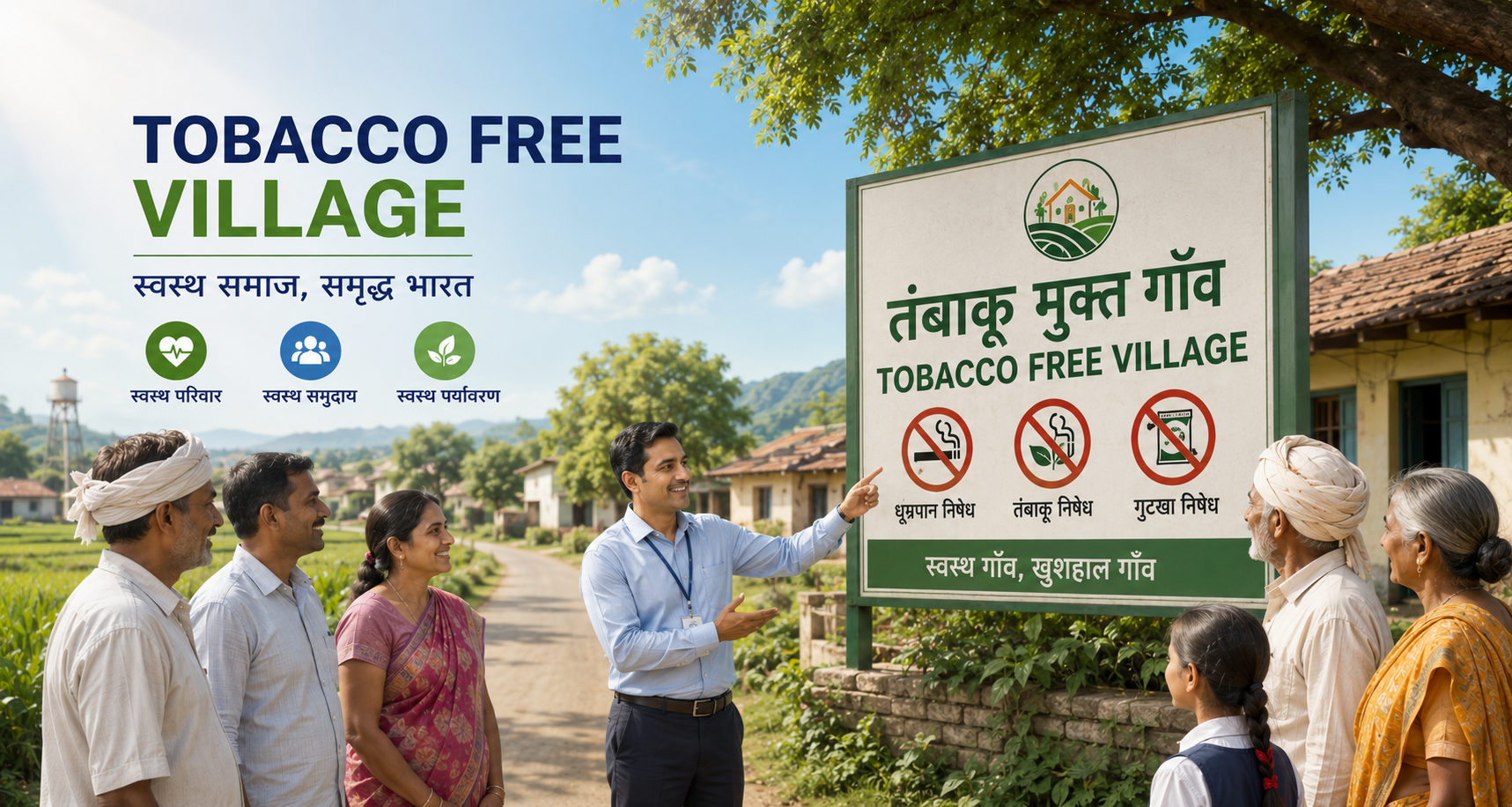
Criteria 8: Display of Tobacco free Area (Annexure I) Signage inside the villages at all prominent place(s) (public places/ bus stops, etc.,) in local language only with mandatory display of name/designation/contact number (minimum of 03) Display of You are entering a Tobacco free Village board at all village entry/approach roads (minimum of 02)
Criteria 9a: The village must follow the following provisions: a) No evidence of tobacco use in public places in the village (cigarette/beedi butts or discarded gutka/tobacco pouches, spitting spots). Criteria 9b: No evidence of sale to minors under the age of 18 within the village. Display of sale of tobacco to minors (under 18 years) is prohibited and is punishable by law at the point of sale.
Criteria 9c: No advertisement of tobacco products in point of sale and in public places. Criteria 10: All Educational Institutions within the village must be ToFEI compliant.
Follow these simple steps to complete your Tobacco-Free Village Compliance Assessment using the digital platform.
Sign in using your registered username and password to access the Tobacco-Free Village portal.
Answer all Tobacco-Free Village assessment criteria and questions accurately.
Upload photographs, documents, resolutions, awareness activity reports, and other supporting evidence.
Monitor assessment progress, verification status, compliance score, and certification updates through your dashboard.